Advantages of the Forex Market


There area unit many benefits of the Forex market over another varieties of monetary commerce.

When talking regarding varied investments that area unit accessible to nearly everybody, there's one kind that springs to mind. The Forex or exchange market has several benefits over different varieties of tradin. Since it's associate over-the-counter (over-the-counter) market, the Forex market is open twenty four hours each day, not like the regular stock or artefact markets. Most investments need a big quantity of cash before you'll be able to make the most of that investment chance. you simply would like atiny low quantity of capital to trade Forex. everybody will enter the market with as very little as $1 to trade a "micro account", that permits you to open positions of one,000 units. One heap of one,000 units of currency is up to one go for small account. every "pip" or "tick" (smallest currency rate movement up or down) is price $0.10 profit or loss, counting on wheather you're going with the market or against it. A Forex mini account offers you management over ten,000 units of currency, wherever one pip is price $1.00. whereas a typical account offers you management over one hundred,000 units of currency, and a pip here is sometimes price $10.00.


Forex is additionally one amongst the foremost liquid markets. once commerce currencies on the spot Forex market you have got full management of your capital, which means that you simply should purchase and sell your positions anytime throughout market open amount. this is often a particular advantage as a result of, if you wish to use your account cash, it are often accessed now while not further commission or waiting periods. several different varieties of investments need holding your cash up for rather long periods of your time.

Also, in Forex, with atiny low quantity of cash, you'll be able to management larger market positions victimization the leverage or margin commerce. Leverage of 1:100 is common within the Fore market. It permits you to manage amounts one hundred times larger than your capital, whereas leverage of 1:500 and 1:1000 are often found with some offshore corporations.

Forex traders are often profitable in optimistic or pessimistic market conditions. securities market traders would like stock costs to rise so as to require a profit, since short-selling may be a subject to strict limits available exchanges. Forex traders will create a profit throughout each uptrends and downtrends. Forex commerce is truly thought of risky however with an honest commerce system to follow, sensible cash management skills, and a few level of self-discipline, the risks of Forex commerce are often decreased  significantly.

The Forex market are often listed anytime and anyplace. As long as you have got access to a laptop and net, you have got the power to trade the Forex market. a very important factor to recollect before jumping into commerce currencies is that it's price active with "paper money", or "fake money", on the demo account. Most exchange brokers have demo accounts wherever you'll be able to transfer their commerce platform and follow in time period with real market knowledge however with "virtual money". whereas profitable demo commerce cannot guarantee your success with real cash, active will provide you with an enormous advantage to become higher ready after you begin commerce along with your real, hard-earned cash.
read more →

Forex Books for Beginners


Here you will find the Forex e-books that provide the basic information on Forex trading. You can learn basic concepts of the Forex market, the technical and fundamental analysis. While all these e-books are recommended for every new Forex trader, they won't be very useful to the very experienced traders.
Almost all Forex e-books are in .pdf format. You'll need Adobe Acrobat Reader to open these e-books. Some of the e-books (those that are in parts) are zipped.
If you are having problems downloading the books and you are using Google Chrome, try right-clicking a book download link and choose 'Save link as...'
If you are the copyright owner of any of these e-books and don't want me to share them, please, contact me and I will gladly remove them.
Candlesticks For Support And Resistance — The basics of trading with candlesticks charts by John H. Forman.
Online Trading Courses — Course #1 lesson #1 by Jake Bernstein.
Commodity Futures Trading for Beginners — by Bruce Babcock.
Hidden Divergence — by Barbara Star, Ph.D.
Peaks and Troughs — by Martin J. Pring.
Reverse Divergences And Momentum — by Martin J. Pring.
Strategy:10 — Low-risk, high-return Forex trading by W. R. Booker & Co.
Trend Determination — A quick, accurate and effective methodology by John Hayden.
Introduction to Forex — by 1st Forex Trading Academy. This trading course intends to provide to all of the students analytical tools on the trading system and methodologies. In this respect, the purpose of the course is to provide an overview of the many strategies that are being used in Forex market and to discuss the steps and tools that are needed in order to use these strategies successfully.
The Six Forces of Forex — by Scott Owens. A small e-book covering the basic and the main problems of Forex trading.
Forex. On-Line Manual for Successful Trading — an introduction into every aspect of the Forex trading including detailed descriptions of the technical and fundamental analysis techniques, by unknown author.
18 Trading Champions Share Their Keys to Top Trading Profits — as the name suggests, the book shares the secrets of the 18 prominent traders with the Forex beginners, by FWN.
The Way to Trade Forex — a 1st chapter of the book that will show you not only Forex basics but also some unusual techniques and strategies that can work for the newbie traders, by Jay Lakhani.
The Truth About Fibonacci Trading — the basic facts and information about Fibonacci levels and their application to the Forex trading, by Bill Poulos.
Quick Guide to Forex Trading — a 2008 edition of the Forex guide for the beginners and private traders issued by Easy-Forex.
Chart Patterns and Technical Indicators — an explanation of the most popular chart patterns and some technical indicators, by unknown author.
Forex Trading — a rather generic all-topic guide for beginners in Forex trading, by Richard Taylor.
Trading Forex: What Investors Need to Know — by NFA. National Futures Association gives introduction to the online retail Forex trading and warns about the potential dangers of such activity.*
My Dog Ate My Forex — by Doug Breiten. A rather generic Forex e-book that, nevertheless, shares some useful insights with the Forex traders on their road to success.
Point & Figure for Forex — by James Chen. An article from 2007 issue of Technical Analysis of Stocks & Commodities magazine. Offers a basic introduction to point-and-figure charting and shows some P&F chart patterns.
read more →

The ‘Coffee Shop’ Forex Traders Movement


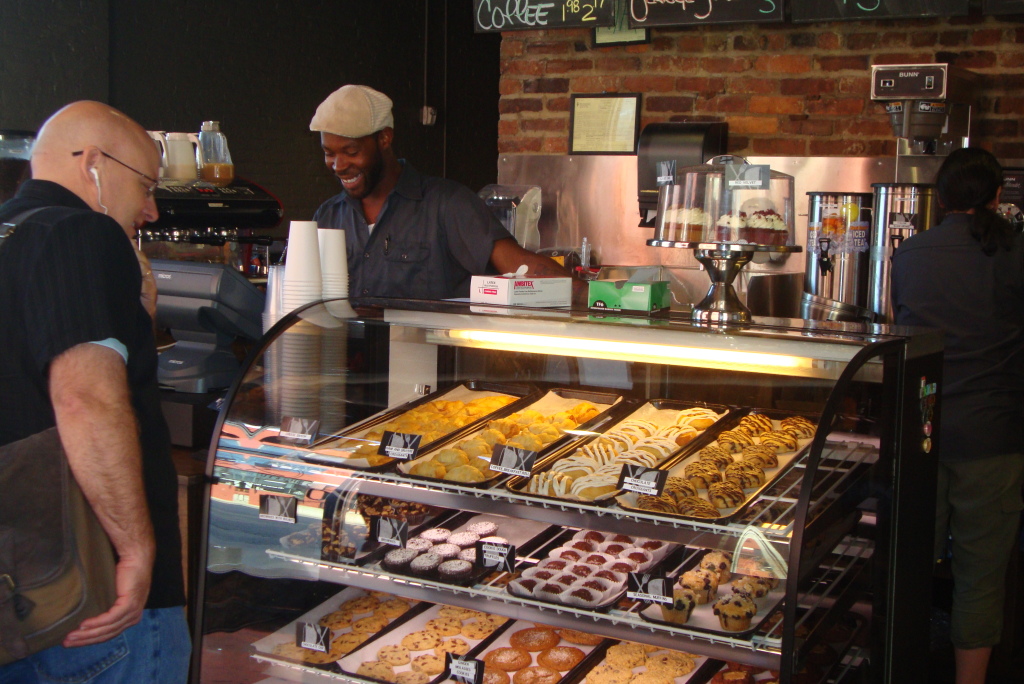
Here at Learn To Trade The Market we are introducing what we call the “Coffee Shop Traders Movement” today. This idea came to me recently as I was – surprise surprise – trading from my laptop while in a local coffee shop. I began thinking about how my trading has morphed over the years from messy, complicated and having a big trading desk with multiple monitors, to its current form which is mobile and minimalistic. Trading in this manner actually helps me to keep emotion and over-trading at bay, because rather than walking into an over-the-top trading room with 10 flat-screen monitors where I might feel compelled to enter a trade, I have everything I need to trade successfully on my pencil-thin Ultrabook laptop.
I have found over the years that if there’s what I call a “damn obvious” price action signal on any given day, I will be able to spot it and trade it just fine with only my laptop, whether I’m at home, at a friend’s house or at a coffee shop. I began to think about how trading in this manner meshes perfectly with the simple scaled-back approach that price action analysis brings…it really completes the package ofminimalistic trading. This is in contrast to the façade of the stereotypical “trader” analyzing and trading the markets on a big stack of flat panel monitors while pouring over countless economic news reports and technical indicators all day.

Why you should become a “coffee shop trader”

Recently, I’ve adopted a “minimalist” approach in my personal life that I had already been using in my trading for years. The way that you become a trader who can trade from a coffee shop, a sofa, or anywhere else, is by simplifying your trading, from the strategy you use all the way down to the hardware and software you trade with. I actually got the idea to “simplify” my personal life from the way that simplicity and minimalism had improved my trading. Just as reducing the clutter and variables on my charts worked to increase my time, money, and overall success level in trading, it had virtually the same effect on my personal life.
Trading is perhaps one of the only professions in the world where doing “less” is better for you. Many people have trouble when they start trading because they are used to working long hours, studying long hours, and generally doing as much as possible at their job or school each day. Thus, it’s natural to assume this philosophy should apply to trading as well.
The problem with this is that your actions have exactly zero effect on the markets…all you can do is analyze them and trade a high probability strategy. After you have learned how to trade your strategy and you feel 100% confident with it, all that’s left to do is open up your charts two or three times a day, look for your trade setups and then either enter a trade, possibly adjust stops or targets from a previous trade, or walk away. This notion that you have to read forex news reports and sit at your computer trying to make sense out of 5 different indicators, Elliot Wave and what the guy on CNBC is telling you…is just ludicrous, unnecessary and counter-productive! So stop it!!

How to become a “coffee shop trader”

Becoming a “coffee shop trader” is really the end result of simplifying your trading strategy, minimizing the time you spend analyzing the markets each day and generally just taking a calm and scaled-back approach to trading. Most traders start off in a somewhat haphazard manner, excited to get started but not yet certain of exactly what they are doing. Over time, we either figure out that less is more, or we give up all together. What I mean by that is that most traders over-complicate the trading process and experience a period of trial and error that is usually defined by losing money. They then either reach a point where they give up on trading all together, assuming it’s too difficult for them or that it “can’t be done”, or they come to the realization that all they need to do is chill out a little bit, solidify and simplify their trading strategy and just stop trading so damn much.

 have found that the simplest approach, and the most effective one, is to simply wait patiently for my price action setups to form on the daily chart or the 4 hour chart (occasionally the 1 hour). I then execute my trade if my edge is present or walk away if it’s not. Most of the time I just let the market do the “work” and give my edge it’s proper time and space to play out, rather than messing around with the trade because I “think” the market will stop me out. It’s a funny thing that many traders have a solid trading edge but then through voluntary interference they fail to give their trades proper time to play out and this likely lowers the probability of their trading edge over time.
Trading higher time frames and low-frequency trading is much more conducive to most people’s on-the-go modern lifestyle. The idea with my “coffee shop traders” approach is that by taking a more relaxed and slowed-down approach to trading, a trader will work to forge the correct trading mindset and trading habits. This is in contrast to the frantic pace of day-trading and trading with messy charts or overly-complicated trading systems that many traders seem to prefer (to their own detriment). The majority of retail traders are people with full-time day jobs, and when they try to be “scalpers” or “day-traders” they simply put themselves in a very difficult situation right out of the gate since they don’t have the time they need to dedicate to trading short time frames. My opinion is that all traders should first master higher time frame trading and only after having found success on the 4 hour chart and above should they consider day-trading or scalping. Most traders seem to go in “reverse” by first getting attracted to day-trading and then later moving to the higher time frame charts after they find out that trying to make money on a 5 minute chart is something only a very experience professional trader should try.

Conclusion

Whereas trading is sometimes thought of as a complicated profession that mainly the Ivy-league elite excel at, I teach my students to scale-back their involvement in the markets to the point where they can trade comfortably from a coffee shop or their own home with nothing more than a wireless internet connection and a laptop or iPad. Taking this simplified approach to trading actually helps most traders improve their performance since trading is a highly psychological profession that tempts many traders to become over-involved with the markets, giving rise to emotional trading mistakes.

Being a “coffee shop trader” is not something that just happens overnight. It really is the end result of having your trading strategy mastered to the point where you are 100% confident in your ability to trade it. This means, you can open up your charts, scroll through them quickly and easily determine whether or not there’s something worth trading. You aren’t sitting there for hours stewing over economic news, Elliott Waves, MACDs, Stochastics, or any other messy and unnecessary analysis tools. The coffee shop trader simply needs his Ultrabook/Laptop PC, an internet connection and his own finely-tuned trading skills.
If the “coffee shop trader” approach interests you, but you just need a solid strategy to get started, then I suggest you look at myprice action trading course. Once you have learned everything I teach in it and truly mastered it, you’ll be able to flip open your laptop and almost instantly know if there’s a trade setup worth risking your money on or not. This is how I personally trade and I wouldn’t recommend any other approach to anyone, it sure as hell beats sitting around staring at the markets all day (and night) wasting your time and becoming confused and frustrated. If you follow my members’ daily trade setups commentary, it will act as an effective guide to the daily charts of some of the major Forex pairs each day and it’s an excellent daily companion to the relaxed style of “coffee shop trading” that we’ve discussed here today.


read more →

5 New Year’s Trading Resolutions For 2013

Here we are at year’s end again, and it’s time to stop trading for a bit and reflect on our past year’s trading performance. This means it’s time to get honest with yourself…how did you fare last year in the markets? Can you honestly say you put forth your best effort at being a disciplined and logical trader or did you behave more like someone on a 1 year gambling binge in Las Vegas? Either way, it’s time to get ready for the New Year and take advantage of the psychological “clean slate” that comes with it. Every trader knows their main weaknesses, so when writing our New Year’s trading resolutions and affirmations, don’t be afraid to focus on your weak points and bring them to the surface. Don’t sugar-coat this; everyone has weaknesses when it comes to trading and if you don’t face them head-on you will never strengthen them. Here are 5 trading resolutions for 2013 to get you started; you can add some more of your own to give yourself a nice list of achievable trading goals for the New Year:

1)  I will aim to be a better person in general

I’ll admit it, this first point isn’t just related to trading, it applies to life in general; it could apply to relationships, your job, business, or even to your studies if you’re a student. One reason why most people don’t achieve their New Year’s resolutions is because they get bogged down doing things that are really just a waste of time. Many people have a hard time making efficient and effective use of their time. Many people struggle when it comes to seeing things through from start to finish, especially when it comes to things they aren’t necessarily “forced” to do like when you’re at work and your boss is watching you.
The secret to becoming a better person and trader is to keep the flow of positive thinking and positive habits going…it can be difficult to get back into the gym regularly or back filling out your trading journal regularly, but it’s simply “getting up on the horse” that is usually the hardest part. Once you get going on the right track you start to develop positive habits, and these habits will reinforce themselves in your brain the more you stick with them, creating confidence and making it more likely that you continue to stay on track and get closer to your trading goals or other life goals.

2) I will stick with my trading method

umping from method to method or system to system is a big reason many traders struggle to make money in the markets. You need to commit to one method this year and stick with it, through the good times and bad. Commit yourself to 12 months of continued study of price action trading, follow the teachings in my trading course and daily commentary and fine-tune your own personal price action trading skill. You need to give it a real crack, even in the face of hardship, account draw downs or low confidence…you have to commit to getting back up on the “horse” and keep going. Every method or system is going to have losing trades…it’s part of trading, you can’t give up every time you have two or three losers in a row.
One proven method that will help you stick to price action trading is to decide to focus on one price action setup at a time and really master it. If you’re a new or struggling price action trader you should read my article from last week on How to Profit with Price Action and follow what I say in it. An excellent New Year’s resolution to get your trading on the right track would be to become a “specialist” of one price action setup at a time. Even if it takes you all of 2013 to accomplish this, you have to ask yourself if that would be an improvement over your 2012 trading performance or not, I’m willing to bet it would be.

3) I will limit my trading screen time to 1 hour per day

Most losing traders tend to spend way too much time looking at their charts, trying to find trades and reading economic news. If you take my simplified approach to analyzing and trading the markets with price action on higher time frames, you’ll be able to quickly scan the markets for your price action setups, you’ll save a lot of time and money by not over-trading and hopefully increase your win rate.
Limiting your screen time like this will eliminate most second-guessing and allow you to make cleaner and crisper trading decisions. It will also leave you more time to do other stuff like spend time with your family or focus more on your day job. It’s ironic that it tends to be the people who spend the least amount of time watching the markets tend to make the most money, at least that’s the feedback I’ve got from dealing with over 8,000 traders since 2008.

4) I will become a “minimalist” thinker

Minimalism is like its own religion for some people; they choose to live as minimalists, while this lifestyle won’t be practical for everyone, we definitely need to trade as minimalists…This includes removing indicators and “clutter” from your charts which only clouds decision making, and generally just taking a “minimalist” approach in all aspects of your trading. We want to abide by a basic set of principles and logic that does not complicate the trading process, price action trading fits that mold perfectly.
I recently wrote an article about my journey of becoming a minimalist in all aspects of my life, and I  actually took the idea from the way that I trade; minimally. It seems as though humans have an innate tendency to over-complicate things, from relationships to trading this seems to be the case. Thus, in 2013 one of your main resolutions should be to become a “minimalist trader”. You can do this by sticking to the simple price action trading strategies that I teach, higher time frame trading, and reducing the amount of time you actually focus on analyzing and trading the markets. This minimalist trading approach is something that dramatically improved my personal trading performance and later my everyday life as I got rid of unnecessary possessions and ‘streamlined’ my life.

5) I will read my daily trading affirmations

What’s a trading affirmation you ask? I actually wrote a good article on this earlier this year, check it out here: Daily trading affirmations. You might want to use some of the affirmations in that article as well as some of your own and write out your own daily trading affirmations list that you read every day before you trade.
Reading affirmations to yourself each day before you look at the markets can be an excellent way to keep you focused and on-track. A big part of becoming a successful trader is just remembering that trading is a marathon not a sprint, and to act accordingly. It can be very easy to fall off the right track and start “trading like a machine gunner”, so having a daily reminder to yourself of what you need to do to achieve success, can be a big help.


read more →

How To Remove Your Losing Money When You Place Trades

If you’re going to be a trader, you’re going to lose money at some point, and in case you are still in the phase of trying to avoid all losing trades and searching for a “Holy-grail” trading system with a 75% strike rate, you should forget about all that right now. As cliché as it may sound, losing really is part of winning as a trader; the two are inseparable. If you don’t learn how to lose properly you will never make consistent money as a trader.
 Some of the key reasons why traders become fearful about losing their money include the following:
1. They don’t understand that mathematically, over a series of trades, a trader can lose a majority of their trades and still be widely profitable, simple math proves this.
2. They are simply fearful of losing money in general.
3. They are trading positions that are too big (risking more than they really should be), causing fear, sleepless nights and huge emotional swings.
In the rest of this lesson I’m going to provide you with some insight into the fear of losing money in the markets and how to conquer it. This is some pretty powerful stuff so make sure you actually read the whole article and re-read it if you have to. What you learn here should give you the power to eliminate your fear of losing money in the markets and will help you develop into a confident and emotionally collected trader.

Fear of losing money can be a good, natural emotion, but we need to transform its focus.

Fear of losing money is a good emotion to have in many areas of life, if we did not have it there would be even more chaos in the world and in the markets. Humans are protective of their acquired wealth and property, and rightly so; they worked hard for it.

Instead of being fearful of losing your money when trading, embrace the control you have on each trade; a trader has complete control over the risk management of every trade via stop losses and position sizing, [and for more advanced traders, derivatives and hedging mechanisms (not discussed here)]. These risk management tools are your way of being in control of your money/funds, and instead of being “fearful” about losing money, you should feel empowered and confident because you can predetermine how much you are comfortable with potentially losing BEFORE you enter a trade by using these tools.

Ask yourself some serious questions

1. Do I really have the knowledge and confidence to be trading with real money in the first place?
If you’re trading your hard-earned money in the markets but you don’t know what your trading edge is and you don’t have 100% confidence in your ability to analyze and trade the markets…you probably should not be trading. One of the biggest reasons traders become afraid to lose their money is because they aren’t confident in their own ability to trade! It seems silly I know, but it’s very true; many traders simply don’t have a trading strategy mastered, they don’t have a trading plan, trading journal, etc…they simply aren’t prepared to risk real money in the markets yet…thus they feel fear when they trade.

2. Am I trading a position size that’s too large for my personal risk profile / per-trade risk tolerance?

If you don’t know what your per-trade risk tolerance is, then you need to figure that out first. It’s basically just the dollar amount that you feel like you are 100% comfortable with potentially losing on any trade; because you CAN lose on any trade…remember that. You have to take into account your overall financial situation and then determine how much money you should realistically and honestly have at risk in the market on any one trade…be honest with yourself here. You’ve got to think of yourself as a risk manager and as someone who is managing funds, rather than just a small-time guy trying to get lucky; your trading mindset will directly influence your trading results.
3. Do I truly understand the math’s behind trading?
When I say the “maths behind trading” I am mainly referring to risk reward and how it relates to your overall winning percentage. For example, on a series of 20 trades, you are likely to lose at least 35 to 45% of the trades, and most traders who are successful lose anywhere from 40 to 50% of the time, some even up to 60% of the time. But, through the power of risk reward you can lose more than you win and still come out very profitable. We will expand on this below.

Embrace the belief that losing is OK

Losing is good if you’re cutting your losses quickly and understand that by doing so you’re simply preserving capital and that your winning trades will pay for your losing trades with profit left over. This is the power of your average risk reward ratio over a series of trades coming into play; we will see this in action below…
Even very profitable traders typically lose more than they win, to prove this point let’s take a look at a case study showing 14 trades with a just a 43% win rate. To be clear, that means you are losing 57% of the time and winning just 43% of the time. It can be hard to associate “losing” the majority of your trades with making money, but as I discussed in one of my recent articles.

Trust your strategy and Trust the maths

As we can see in the hypothetical track record above, the math shows us that even while losing 57% of our trades, if we let our winners run to around 2 to 1 or better and cut our losses at -1R or less, the profits will take care of themselves. It’s worth noting we included a couple of 1.5R winners, because sometimes it will make more sense to take a reward of slightly less than 2R, depending on market conditions. The average risk reward in this example was 1:1.75, and if you can aim for an average risk reward of around 1:1.5 or 1:2, over the long run you should come out ahead. The “secret” is keeping ALL your losers at 1R or less and ONLY trading when our price action trading edge is truly present.


read more →

2 Fixed-Income Fund Buys

This issue, we are saying goodbye to the group’s lowest yielder, Vanguard GNMA Fund (VFIIX). Its indicated yield has steadily declined over the last five years, together with mortgage rates, and now stands at only 2.2%. The fund also isn’t without its risks.
  • First, interest rate risk: as rates rise—the only direction they can go from here—the prices of fixed-income instruments (bonds) must decline. This is fully applicable to GNMA securities.
  • Second, as rates go up, refinancing will decline and GNMA fund managers will likely lack the capital they would need to reinvest in more attractive, higher-coupon new issues. Sell.
  • Note that two pure bond funds still remain in our portfolio, PIMCO Total Return (PTTDX) and Loomis Sayles Bond (LSBRX), and both also remain recommendations. These two funds have much more flexibility concerning instruments in which they can invest.
    Why is that important? While neither fund can fully counterweight the inherent risks of bond investing (i.e. interest rate risk), they can and do manage duration, credit, country, and, to some extent, they also even venture into other asset classes (in case of the Loomis Sayles fund).
    Just look at the total annual performance for 2012 and the funds’ current yield. PIMCO’s current yield is 2.4%, but the fund returned 9.93% in 2012 (placing this fund in the top 14% of the intermediate-term bond category).
    Loomis Sayles Bond did even better for 2012: with total return of 14.77% it’s also in the top 14% of its multi-sector bond category. The higher return and higher yield of 5.4% here indicate a higher level of risk, but owning shares in this fund are well worth those risks. We are keeping both in the portfolio, and at these levels, both funds remain buys.
    What to do now: Sell Vanguard GNMA, but you can still buy PIMCO Total Return and Loomis Sayles Bond for the fixed-income portion of your portfolio.
     
read more →

Focus on Currencies with Strong Trends

One of the first steps in any set-up for me is to determine the directional bias of the pair, in other words: Is it trending? For any trader who has watched the strong trends develop in yen pairs, it’s easy to understand it’s been more about yen weakness than the strength of the base currency in those pairs. In fact, IF and WHEN the base currency has been strong that really has been just another reason to look for more upside. The only reason any trader could be bearish a yen pair longer-term is IF they see a significant enough reason for the yen to strengthen OR expect more weakness from the base currency than the weakness expected from the yen.


The yen may have had two sessions of buying momentum—triggered by a BOJ that failed to meet the über-bearish expectation of traders—just above the 1.1100 major psychological level, but this is a shallow correction at best; one that did not even challenge the dynamic resistance of the 20DMA. Further support of the yen’s re-weakening can be found in the continual higher highs in the Dow Jones (YM).
I continue to like the New Zealand dollar strength story as it benefits from the strong and steady Chinese data without the overhang of a dovish central bank (like the aussie has). In fact it has been one of the strongest currencies through the month and the strongest of the comm-dolls.
NZD/JPY
Playing the NZD/JPY long set-ups is ideally suited for traders looking to take advantage of a weak yen and the strong kiwi, which together have this pair “firing on both cylinders”! Even if/when the kiwi weakens, expectations are for resumed strength and there is little doubt that the yen will outpace any kiwi weakness in the longer term, hence pullbacks will be bought fairly aggressively.
GBP/NZD
Another pair that has ended up on my radar is the GBP/NZD. With a fresh downtrend confirmed by the consecutive red GRaB candles and “four to six o’clock” 34EMA Wave, bounce in this pair on pound strength and/or kiwi weakness should be sold unless the RBNZ changes their tune to hold rates steady. The MPC last week took any wind there was in the pound’s sails and accelerated the bearish sentiment and momentum.


read more →